Youth Soccer Training Equipment: What Actually Works
Youth Soccer Training Equipment: What Actually Improves Players (and What Just Fills the Garage)
Every soccer parent I meet in Houston has the same garage. A rebounder that gets used twice a month. Two sets of cones. An agility ladder still in its packaging. Maybe a weighted ball someone recommended.
None of it is bad equipment. Most of it just doesn't do the thing the player actually needs.
I've spent 30 years in the energy industry making capital decisions, and I now spend my time putting professional soccer training technology in front of Houston clubs, academies, and families. The question I get asked most often is some version of "what should I buy?" — so here is the honest answer, including the parts that don't sell anything.
The one question worth asking about any piece of kit
Before you buy anything, ask this: does it force the player to make a decision?
Almost every technical problem you see in a 12-year-old — the heavy touch, the pass into a marked player, the head that stays down — is not a technique problem. The technique is usually fine in isolation. It falls apart when the player has to scan, choose, and execute at speed.
That's the gap. And it's the gap most training equipment doesn't touch, because most training equipment is passive. A cone doesn't move. A rebounder returns the ball to the same place every time. The player knows what's coming before it comes, so the hardest part of the game — deciding — never gets trained.
Once you have that filter, the categories sort themselves out quickly.
Cones, ladders, and poles
What they're good for: movement patterns, footwork mechanics, warm-ups, and running a session for 20 kids at once on a tight budget.
What they don't do: anything unpredictable. An agility ladder trains foot speed in a fixed pattern. That's a real thing, and it isn't nothing — but a player who is quick through a ladder is not necessarily quick when they have to react to a defender.
Verdict: buy them. They're cheap, every coach needs them, and they earn their place. Just don't expect them to develop game intelligence, because they can't.
Soccer rebounders and rebound nets
What they're good for: volume. A soccer training rebounder means a player can get hundreds of touches on their own in a driveway, which is genuinely useful for first-touch repetition and for a kid who wants to train without needing a partner.
What they don't do: vary. The ball comes back to roughly the same spot at roughly the same speed. The player's eyes stay on the net. There's no scanning, no choice, no consequence for picking the wrong option — because there's only one option.
Verdict: the best value item in the at-home category, and worth owning. Treat it as a repetition tool, not a development tool.
Apps and video-based training
What they're good for: structure and accountability. A good app gives a player a session plan, a streak to protect, and a library of drills that a parent who never played can still supervise.
What they don't do: measure the thing that matters. Most apps track whether you completed the session, not how well you performed it. The feedback loop is self-reported. And for a player training alone, the app can only tell them what to do — it can't tell them whether the touch was good.
Verdict: useful for consistency, especially over a long off-season. Not a substitute for measured, pressured repetition.
Electronic soccer training equipment: interactive arenas and light-based systems
This is the category most people haven't seen up close, so it's worth explaining properly.
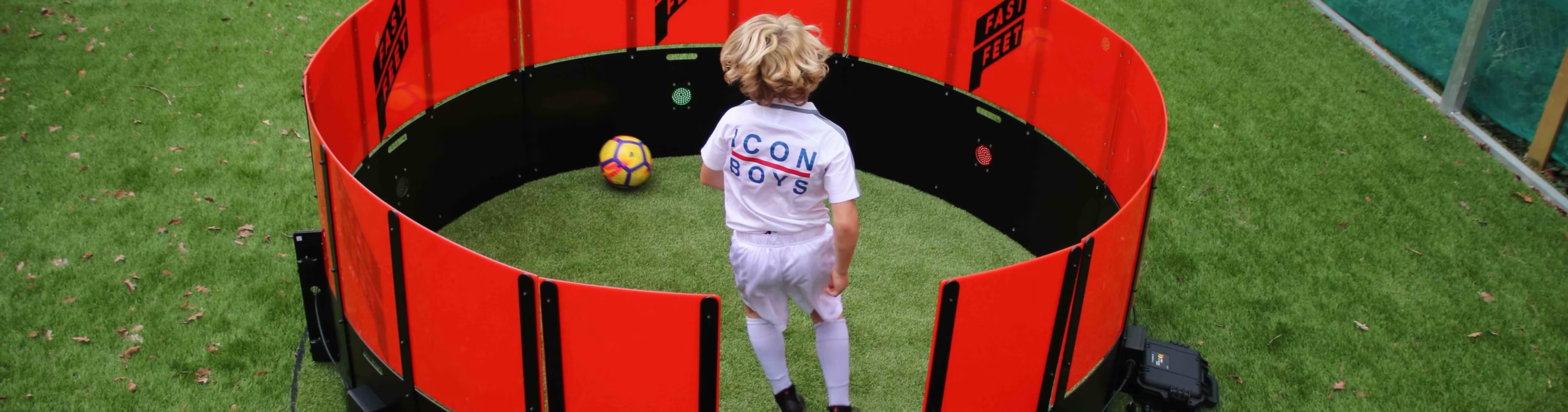
An interactive soccer training system is a set of sensor panels arranged around the player — in a circle, along a wall, or spread across a pitch. Lights tell the player which target to hit. The panel registers the strike. The system scores it, times it, and shows the result immediately.
What that changes is the decision. The player doesn't know where the next light will appear. They have to keep their head up, find it, choose, and execute — and if they choose slowly, the score tells them so, in front of everyone.
The Elite Skills Arena systems we work with run modes that make this explicit. Pass Finder puts one moving target in play, then two, so the player has to judge which option is quicker as well as hit it. Pass Finder React adds a high-value light that appears for a limited window, so priorities change mid-sequence. Memory shows a sequence and asks the player to reproduce it, with one mistake ending the run. Passing Index puts targets of different values in play at once, so accuracy has to be balanced against decision-making.
Those aren't drills a cone can run.
The other difference is repetition density. The ICON is a circular arena of 12 to 24 targets, and because the ball rebounds straight back to the player, the touch count is far above anything they get in a match — 40 to 50 touches a minute, sustained. A player in a competitive game might get 50 or 60 touches across the whole 90. That gap is the entire argument for this category.
It's also why professional clubs use these systems for return-to-play. The ICON gives a recovering player controlled, low-impact, high-repetition contact time before they rejoin full training. That's a rehab use case, not a marketing one — and it's a large part of why FC Barcelona, Manchester City, AC Milan, and Inter Miami have this equipment.
What they don't do: replace playing. No arena teaches a player to defend, to press as a unit, or to read a game over 90 minutes. Anyone selling you an arena as a substitute for football is selling you something.
Verdict: the only category on this list that trains decision-making under pressure and measures it. Also, by some distance, the most expensive — which is why the next section matters more than this one.
Comparison
$
Develops technique | Develops decision-making | Gives objective feedback | Trains alone | Cost | |
|---|---|---|---|---|---|
Cones, ladders, poles | Partly | No | No | Yes | $ |
Rebounder / rebound net | Yes | No | No | Yes | $$ |
Training app | Partly | No | Self-reported only | Yes | $$ |
Interactive arena | Yes | Yes | Yes, instantly | Yes |
What I'd actually tell you to buy
This is where most equipment articles stop being useful, so let me be direct about it.
If you're a parent of a player under 12: a ball, a rebound net, and a wall. That's it. Spend the money you were going to spend on gadgets on more playing time instead. At that age, touches and enjoyment beat measurement.
If you're a parent of a serious 13+ player with college ambitions: the rebounder still does the volume work. What's worth paying for on top is measured sessions — somewhere they can get scored, timed, and benchmarked a couple of times a month, so you and they can see whether the work is landing. You do not need to own an arena to get that. You need access to one.
If you're a club or academy director: the calculation is different, because you're amortising across a whole player base. An arena is a five-figure capital purchase, which is exactly why we lease as well as sell — most Houston-area youth clubs I speak to can justify the equipment on a monthly basis long before they can justify it as an upfront purchase. The modular Circuit system, developed with FC Barcelona's staff, sets up in under five minutes and can be reconfigured for whatever tactical scenario your coaches are working on that week, which makes it easier to fit into an existing session plan than a fixed installation.
If you're a facility operator: the commercial case is different again. The Precision Wall simulates goalkeeper reactions and generates paid usage between club bookings. Different maths, same equipment.
Where we fit
The Fitba Factory is the Elite Skills Arena agent for Texas, based in Sugar Land. If you want this equipment in the Houston area — bought, leased, or just used for an afternoon — we're the route to it.
For clubs and academies, that means demos, purchase, and lease agreements. For families, it means you can put your player in front of this equipment at an event or a session without buying anything. And for companies, the same technology runs corporate team days that work equally well for people who've never kicked a ball — we handle setup, facilitation, and pack-down.
More detail on the individual systems is on our technology pages.
If you want to see it rather than read about it, get in touch and we'll bring a unit to one of your sessions. No presentation, no proposal — just the kit doing its thing.
Frequently asked questions
What is a soccer training device? It's any piece of equipment designed to develop a specific soccer skill outside of a match — from a cone or an agility ladder, through rebound nets and weighted balls, up to electronic soccer training equipment that uses sensors and lights to set targets and score the player's response. The useful distinction isn't price, it's whether the device is passive (it does the same thing every time) or reactive (it changes, so the player has to decide).
What soccer training equipment do you actually need? For a youth player training at home: a ball, a rebound net, and a wall covers the majority of useful solo work. Cones and an agility ladder are worth adding for footwork. Everything beyond that should be justified by a specific gap you can name.
What is the best soccer training equipment for youth players? It depends on what you're trying to fix. For touch volume, a rebounder. For footwork, cones and a ladder. For decision-making, scanning, and reaction speed under pressure, an interactive arena is the only category that trains and measures it — but access matters more than ownership for most families.
Is expensive soccer training technology worth it for a youth club? For an individual family, usually not. For a club or academy spreading the cost across a full player base, and using it for assessment and return-to-play as well as training, the maths changes considerably. Leasing removes the upfront capital question entirely.
What are the latest innovations in soccer training equipment? The meaningful shift is from passive equipment to sensor-based systems that create unpredictability and measure the response — light-triggered targets, motion sensing, and instant scoring. That's what lets equipment train decision-making rather than just technique.
Can interactive soccer training equipment be used indoors? Yes. The ICON arenas need between 16 and 64 square metres depending on size, weigh 15–20kg, run off mains power or battery, and are waterproof, so they work indoors, on turf, or outdoors on grass.
Do you serve clubs outside Houston? We're based in Sugar Land and cover the Houston metropolitan area, with rights across Texas. If you're further out, ask — the equipment is portable by design.